
|
||||||
| Home | About SCP | News and Press | People | Publications | Internal | |
| The Hubble Space Telescope Cluster Supernova Survey: An Intensive HST Survey for z>1 Type Ia Supernovae by Targeting Galaxy Clusters | |||||
| Survey Paper: Dawson et al. (The Supernova Cosmology Project) 2009, AJ, 138, 1271 [ADS] [arXiv] We present a new survey strategy to discover and study high redshift Type Ia supernovae (SNe Ia) using the Hubble Space Telescope (HST). By targeting massive galaxy clusters at 0.9 < z < 1.5, we obtain a twofold improvement in the efficiency of finding SNe compared to an HST field survey and a factor of three improvement in the total yield of SN detections in relatively dust-free red-sequence galaxies. In total, sixteen SNe were discovered at z > 0.95, nine of which were in galaxy clusters. This strategy provides a SN sample that can be used to decouple the effects of host galaxy extinction and intrinsic color in high redshift SNe, thereby reducing one of the largest systematic uncertainties in SN cosmology. | |||||
| Data Releases | All Transient Candidates | ||||
| Detailed information on each transient candidate, like this: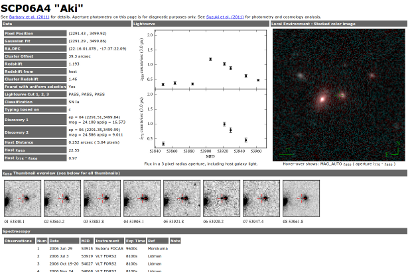
SN Light Curves
| Survey Statistics
|
| 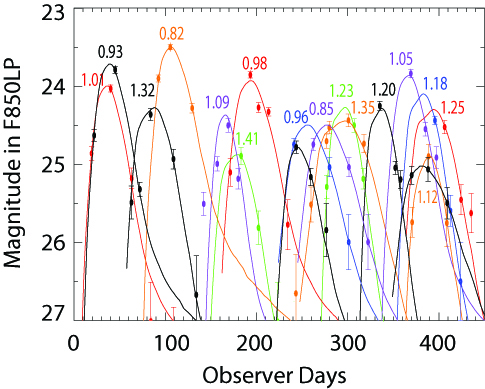
SN lightcurves and z850 AB magnitudes of the high redshift SNe discovered in the survey. Each lightcurve is labeled with the SN redshift in the same color. NICMOS and i775 observations are not shown, nor are additional SNe at z<0.8.
| 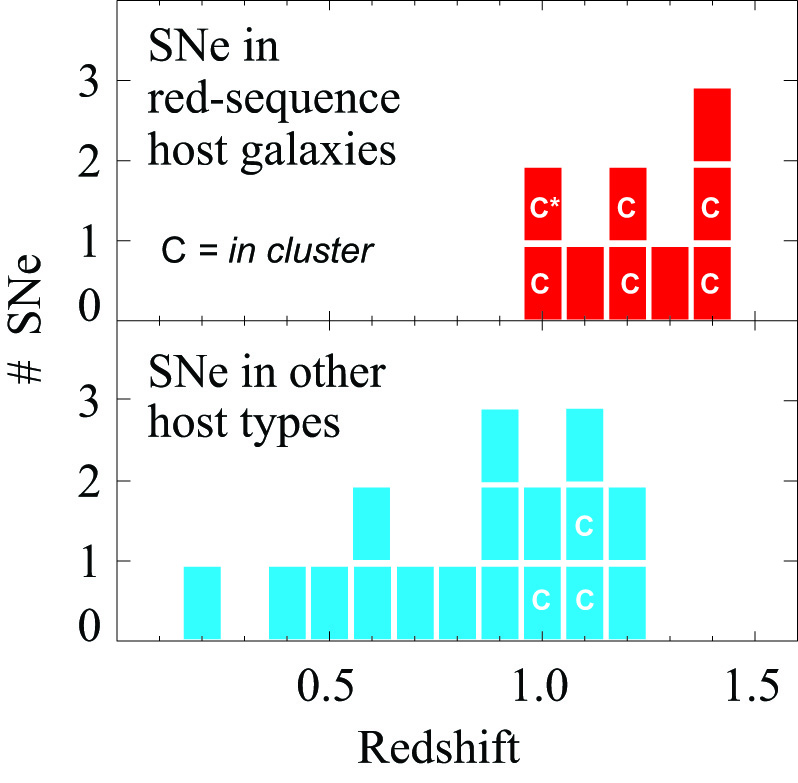
The redshift distribution of the SNe discovered in our ACS program. The upper panel shows the distribution of red-sequence galaxies that had SNe Ia, with the cluster members indicated by ``C''. The asterisk indicates [OII] emission in the spectrum of a galaxy with red-sequence color and spectral features as explained in the text. The lower panel shows the distribution for the other SN hosts. For z > 0.95, the number of SNe in cluster galaxies (9) is comparable to the number of SNe in field galaxies (7). |
| Publications from this HST Cluster Survey : Supernova | |||||||
|
An Intensive HST Survey for z > 1 Supernovae by Targeting Galaxy Clusters
(Paper I) Dawson et al. 2009, AJ, 138, 1271 [ADS] [arXiv] The Hubble Space Telescope Cluster Supernova Survey: II. The Type Ia Supernova Rate in High-Redshift Galaxy Clusters Barbary et al. 2012a, ApJ, 745, 32 [ADS] [arXiv] [pdf] The Hubble Space Telescope Cluster Supernova Survey: III. Correlated properties of Type Ia Supernovae and their Hosts at 0.9 < z < 1.46 Meyers et al. 2012, ApJ, in press [ADS] [arXiv] The Hubble Space Telescope Cluster Supernova Survey: IV. NICMOS Calibration for Faint Sources using Red-Sequence Cluster Galaxies Ripoche et al., ApJ, submitted The Hubble Space Telescope Cluster Supernova Survey: V. Improving the Dark Energy Constraints Above z>1 and Building an Early-Type-Hosted Supernova Sample Suzuki, Rubin, Lidman et al. 2012, ApJ, in press [ADS] [arXiv] The Hubble Space Telescope Cluster Supernova Survey: VI. The Volumetric Type Ia Supernova Rate Barbary et al. 2012b, ApJ, 745, 31 [ADS] [arXiv] [data] The Detection and Removal of Large-Scale Detector Background Structures in NICMOS Observations Hsiao et al. 2010, 2010 STScI Calibration Workshop Proceedings [ADS] Subaru FOCAS Spectroscopic Observations for High-Redshift Supernovae Morokuma et al. 2010, PASJ, 62, 19 [ADS] [arXiv] Discovery of an Unusual Optical Transient with the Hubble Space Telescope Barbary et al. 2009, ApJ, 690, 1358 [ADS] [arXiv] [Webpage & Data] Rest-Frame R-band Light Curve of a z ~ 1.3 Supernova Obtained with Keck Laser Adaptive Optics Melbourne et al. 20007, AJ, 133, 2709 [ADS] [arXiv] | |||||||
| Publications from this HST Cluster Survey : Weak/Strong Lensing | |||||||
|
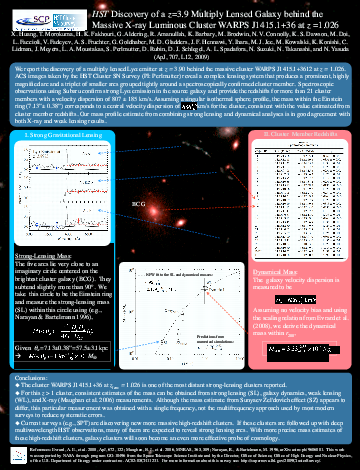
Scaling Relations and Overabundance of Massive Clusters at z>~1 from Weak-Lensing Studies with HST Jee et al. 2011, ApJ, 737, 59 [ADS] [arXiv] Hubble Space Telescope Weak-Lensing Study of the Galaxy Cluster XMMU J2235.3-2557 at z = 1.4: A Surprisingly Massive Galaxy Cluster when the Universe is One-Third of its Current Age Jee et al. 2009, ApJ, 704, 672 [ADS] [arXiv] HST Discovery of a z=3.9 Multiply Imaged Galaxy Behind the Complex Cluster Lens WARPS J1415+36 at z=1.026 Huang et al. 2009, ApJL, 707, 12 [ADS] [arXiv] | |||||||
| Publications from this HST Cluster Survey : Cluster Science | |||||||
|
X-ray Emission from Two Infrared-selected Galaxy Clusters at z > 1.4 in the IRAC Shallow Cluster Survey Browdin et al. 2011, ApJ, 732, 33 [ADS] Cluster galaxies in XMMU J2235-2557: galaxy population properties in most massive environments at z ~ 1.4 Strazzullo et al. 2010, A&A, 524, 17 [ADS] Multi-wavelength study of XMMU J2235.3-2557: the most massive galaxy cluster at z > 1 Rosati et al. 2009 A&A, 508, 583 [ADS] Multiwavelength observations of a rich galaxy cluster at z = 1. The HST/ACS colour-magnitude diagram Santos et al. 2009 A&A, 501, 49 [ADS] The XMM Cluster Survey: Galaxy Morphologies and the Color-Magnitude Relation in XMMXCS J2215.9-2013 1738 at z = 1.46 Hilton et al. 2009 ApJ, 697, 436 [ADS] Clusters of Galaxies in the First Half of the Universe from the IRAC Shallow Survey Eisenhardt et al. 2008 ApJ, 684, 905 [ADS] The XMM Cluster Survey: The Dynamical State of XMMXCS J2215.9-1738 at z = 1.457 Hilton et al. 2007, ApJ, 670, 1000 [ADS] |
|||||||
| Posters from AAS 2010 | |||||||
|
|
|
|||||
|
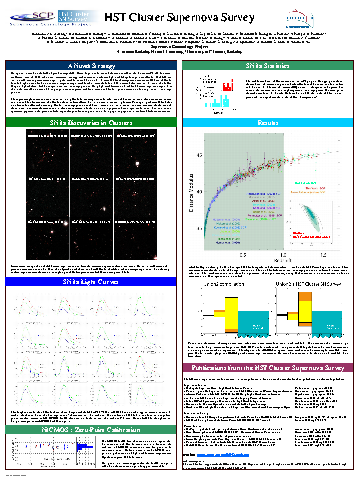
HST Cluster Supernova Survey
More to come very soon! |
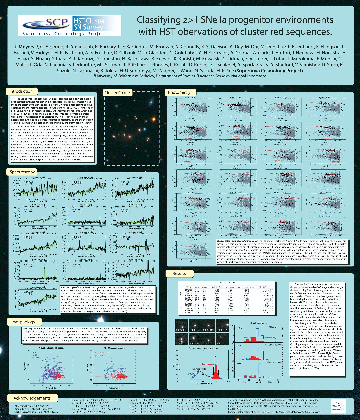
HST Discovery of a z=3.9 Multiply Lensed Galaxy behind the Massive X-ray Luminous Cluster WARPS J1415.1+36 at z =1.026 | Classifying z>1 SNe Ia progenitor environments with HST obervations of cluster red sequences. | |||||